So last Friday was the second of three meetings between the postgrads of Bristol, Exeter and Cardiff. We are also welcome to give talks on our work so far, which is mainly taken up by second and third years due to the recent of stars of 1st years like me. There were a couple of really interesting talks from Cardiff students and it was very nice to properly understand what people are working on. The talks from the Bristol and Exeter students gave great variety and made us all remember that there are different areas of astrophysics than just those covered by our universities.
Universities always seem to focus on certain areas; it's impossible to have good coverage of all subjects. Cardiff for instance focuses on Galaxies, Gravitational Waves, Star Formation and to a lesser extent Cosmology. However we have little or no current research into Solar physics or Planetary physics. These meetings are great at giving us all a bit of current knowledge in different areas of research.
Hopefully at the final meeting or one next year I can present my work, but at the moment I'm just enjoying learning about other fields of research.
Saturday, 16 March 2013

Sunday, 24 February 2013
Procrastination time
As part of my PhD I have to give a presentation every year on an interesting paper, which is open to the whole of the department to come along, but 10 people is usually a good turn out. It's only about 20 minutes, the paper can be on anything physics-y, but should preferably be interesting. No pressure.

I had no idea what to do but have decided on a paper on the discovery of the first planet by the PlanetHunters website (PH1). This website allows people to look at data from the Kepler spacecraft, which aims to discover exoplanets, planets around other stars in the universe. A simple set of images can be used to detect a planet, which the keen PlanetHunters look through, maybe taking only a few seconds per image. The rewards are potentially your name on the discovery paper and the joy of being one of a few individual people scouring data discovering planets, rather than the computer programs which tend to do it nowadays.
The exoplanet in my presentation orbits around a binary star system - two stars which in turn orbit each other. Which in turn orbit around two other stars, which themselves orbit each other. Confused? Me to. Look at the picture below :)

Anyway, I have to present tomorrow and I have done nothing so far, so I better get going. Happy Sunday!
Sunday, 9 December 2012
A sad day

A sad day today as we lost Sir Patrick Moore. I'm a bit too young and a bit too new to really taking an interest in physics to have seen or read much of his work, but the name Patrick Moore is known by so many people, no matter how interested in astronomy you are. The world of science, physics and astronomy are all made stronger by the people who make it sound as interesting as it is. And Sir Patrick Moore was one of those people.
‘Patrick is irreplaceable. There will never be another Patrick Moore. But we were lucky enough to get one.’
Thursday, 6 December 2012
How many piano tuners are there in Chicago?
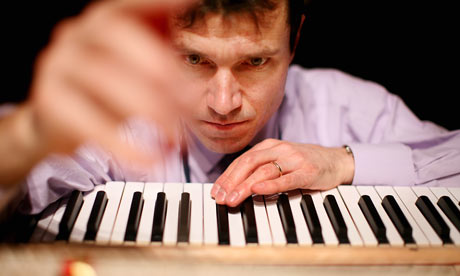
Image thanks to the Guardian website.
A question that has puzzled mankind for centuries. Many sleepless night have been had whilst man worries over this important issue. Well, maybe that's an exaggeration, but some people might worry about it. Imagine you are a piano tuner and are moving near the Chicago area. You want to open a piano tuning business, but you're worried that the market is already saturated. There are too many tuners and not enough pianos. How would you decide whether there was space for your business in the city? Well thankfully a man called Enrico Fermi, a famous Italian physicist has done the work for you. He even did it without a phone book. So how did he do it?
Well, he used a basis of assumptions to estimate the number. So lets run through the process.
There are roughly 5million people in Chicago.
On average there are 2 people her household, so there are 2.5 million houses.
Assume that 1 in 20 households has a piano, which they care enough about to tune regularly.
A piano needs to be tuned about 1 time a year.
Assume a piano tuner, including travel time, takes 2 hours to tune a piano.
A piano tuner works 8 hours a day, 5 days a week, 50 weeks a year.
So from this we calculate there are: 2.5million divide by 20 piano owning households multiplied by 1 tuning per year =125thousand piano turnings per year
The average piano tuner in one year repairs: 4 pianos a day, 20 a week, 1000 a year ((8/2)x5x50). This means there are 125thousand divided by 1thousand = 125 piano tuners in Chicago.
But how can we rely on values which are so broad and based on assumptions. Well the idea is that for every value which is a little bit too high, there is a value which is a little bit too low. By combining all of these estimates, which may be a little bit out, we will tend towards the correct value.
This idea can also be transferred to many other problems. Fermi for example calculated the strength on a test nuclear explosion by dropping paper near the blast and noting how far the paper travelled after the blast. It shows that by using a series of approximations one can begin to make strong assumptions. They are not worthy of scientific results, but they are for getting an pre experiment estimate of the value we might get, or for less scientific tests.
How about how many apples are eating in the uk in one year? Or if the land of the whole earth were equally shared between everyone, how much would everyone get? They're great things to jot down on a piece of paper when you're bored, and often you can find the actual answer on the Internet after you've finished.
And before you ask, I don't know how many actual piano tuners there are in Chicago, though a website I found once suggests its near 80. Not a bad guess then!
Saturday, 1 December 2012
Water water everywhere, but not a drop on mars
....yet. News from NASA this week that they have discovered ice on the surface of mercury. Its hard to believe that the closest rock to the sun can harbour ice, when on earth we are beginning to worry that our icecaps are melting.
It appears that the cool shadow of the craters at the pole of the planet protects the ice from the sun, keeping it at a nice cool stable temperature.

I saw this meme a couple of days ago, and after chuckling to myself for a second, I did feel I should point out that we do know there is ice on mars, also located at the poles. We are even confident that it contains water ice. However the recent observations of mercury suggest that it's water ice, but there is still an uncertainty on this. On Mars we are looking for liquid water, or traces of its existence at least.
The surface of mercury, it has to be said, maybe isn't the most exciting in the solar system, but it does seem to still hold some secrets for us!
It appears that the cool shadow of the craters at the pole of the planet protects the ice from the sun, keeping it at a nice cool stable temperature.
The surface of mercury, it has to be said, maybe isn't the most exciting in the solar system, but it does seem to still hold some secrets for us!
Saturday, 17 November 2012
Collaborating over physics and beer choices
Cardiff is lucky enough to be part of a new group of universities, along with Exeter and Bristol, whose post graduates will regularly meet throughout the year and discuss the work we all do. Hopefully this will encourage work between the universities, improve our presenting skills and prepare us newbies on how scientific conferences work.
Yesterday was our first meeting, in Bristol, and I think everyone agrees it was a great success. It often feels in science that there is a fear of collaborating with other unievrisites and people too closely, a fear that people ideas will be diluted or stolen if shared with other people. A fear which is probably based on previous experience. But for the younger generation of scientists, surely for the future of research if will be beneficial to share our knowledge and ideas, as long as its in the right way.
So overall I think it was a very productive day and I look forward to the next one in the coming year.
The usual trip to the pub afterwards, for a beer and a pizza, also helped everyone come together. Talking at the conference is great, but its the relationships you build beyond your work which will make you want to work with someone again, I believe.
I hope these kind of collaborations exist throughout the UK, and throughout the world, because I believe the success of science comes from a strong community, not a strong set of individuals.
Yesterday was our first meeting, in Bristol, and I think everyone agrees it was a great success. It often feels in science that there is a fear of collaborating with other unievrisites and people too closely, a fear that people ideas will be diluted or stolen if shared with other people. A fear which is probably based on previous experience. But for the younger generation of scientists, surely for the future of research if will be beneficial to share our knowledge and ideas, as long as its in the right way.
So overall I think it was a very productive day and I look forward to the next one in the coming year.
The usual trip to the pub afterwards, for a beer and a pizza, also helped everyone come together. Talking at the conference is great, but its the relationships you build beyond your work which will make you want to work with someone again, I believe.
I hope these kind of collaborations exist throughout the UK, and throughout the world, because I believe the success of science comes from a strong community, not a strong set of individuals.
Thursday, 15 November 2012
My 15 minutes of Fame!
So, at the beginning of this week I received an email from a journalist who was writing a piece on the graduate scheme at ESA. He wanted to talk to someone who had worked at ESA as a graduate and to write a small piece on it.
Luckily, my profile must have been the one he saw first, and so a few days later my brief interview has made it into the British newspaper The Times (15/11/2012). Specifically in the graduate section, which is on the middle page.
It's not a lot, but I meant every word about how good working for ESA is and I really hope more people apply for the positions and carry on in Astrophysics as a result.
The piece is below :)

Luckily, my profile must have been the one he saw first, and so a few days later my brief interview has made it into the British newspaper The Times (15/11/2012). Specifically in the graduate section, which is on the middle page.
It's not a lot, but I meant every word about how good working for ESA is and I really hope more people apply for the positions and carry on in Astrophysics as a result.
The piece is below :)

Subscribe to:
Posts (Atom)