Last night was our second public demonstration of our Virtual reality apps. Here in Cardiff there is a fun science centre called Techniquest. Every month they do an adults only evening where over 18's can be kids again and play with fun science demonstrations and experiments, whilst also having a beer! Normally alcohol and science would be a bad thing, but here it is most certainly a positive!
Techniquest very kindly let us go along to show off our two astronomy VR apps, 'Our Solar System VR' and 'Our Universe in Light VR'. To say the event was successful would be an understatement. In just a few hours we reckon we showed the apps off to around 150-200 people! We had a queue out of the door of people wanting to use the apps, they were that popular!
The feedback was really great (my job today has been to go through all of our feedback forms, which is no easy feat!) and people commented how great the VR apps were. The 'Oohs' and ''Wows' are probably the best indication of just how much people enjoyed them.
Over 200 people have already downloaded the solar system app from the app store, which is fantastic. We're hoping to get this even higher, so if you haven't got it already, what are you waiting for!?!
Last night I was one of the speakers at Science Cafe Cardiff, as part of their monthly events where scientists, engineers, mathematicians and general STEM people give informal public talks in a pub! I was lucky enough to be able to talk about the Virtual Reality project I'm running, showing off the Solar system and Universe in light apps. Luckily the whole event didn't finish late, but there's something about organising and giving public demonstrations that tires you out!
I gave a presentation on the project, the apps and the reasoning and science behind them, but the main aim was to let people play around with the VR headsets. Virtual reality seems to futuristic. 6 months ago I had never used VR, but now I can't imagine being without it. It's great to see people using it for the first time, slowly and cautiously moving their head as they realise they are able to look around. The best bit is when people put their arms out to try and touch a virtual planet, so immersed in the VR world that they almost think it's real.
We got loads of great feedback and questions at the end. I have about 30 feedback forms to work through and see what people thought, which is really good. Next week I'm at the Techniquest science centre demoing the apps as well, which should be really fun and hopefully a bit more relaxed!
Today, on the 29th of September 2015, we have found water on Mars. This is the first time the life giving liquid has been confirmed on another body than our own planet. To say this is one of the most amazing discoveries in science is an understatement. Life has existed on our planet for billions of years, only possible by the liquid water which covers two thirds of our planet. If we are to ever discover life out there in the Universe, the day we first found water on a planet other than our own will be remembered as the first step!
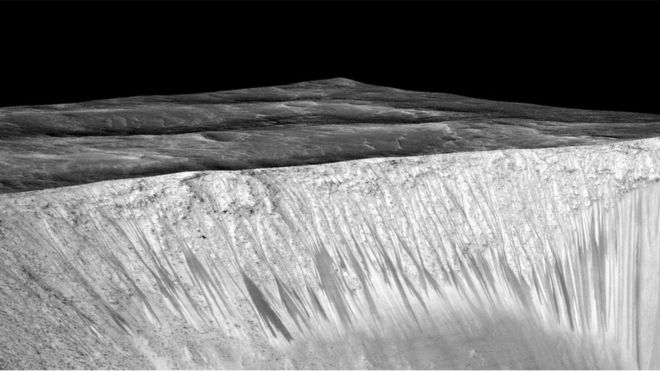
But let's calm down. What exactly has NASA found? Well, NASA has been looking at the large slopes on the surface of the red planet and have noticed something interesting. Using the Mars Reconnaissance Orbiter, a satellite orbiting Mars, scientists have been studying these slopes and specifically looking at the chemicals present. What they've found is that in the summer months, long trails of salt appear, cascading down the slopes. The cause of this? Salt water trickling down the slopes, depositing the salt behind, before disappearing. The fact these only appear in the summer and disappear in the winter suggests Mars is warm enough in the Summer so that salt water can exist in liquid form. This is therefore evidence that liquid water does still exist on Mars!
Streaks of salt down the side of slopes on Mars are signs of water flow.
But where does this water come from each summer? Well we're still not quite sure, but it could be that the salt itself absorbs the water from the atmosphere. Whatever the reason, water is some how collecting in large enough quantities to create these metre long streaks down the sides of slopes on Mars.
But think back to your school days. Remember when your teacher told you Mars was beyond the orbit of Earth, beyond the goldilocks zone, where less of the Suns energy reaches the surface of the planet. Here, without a thick atmosphere like Earth, any water on Mars is frozen solid. We know this because we can see frozen water ice caps at the poles of Mars. So, how then has NASA found liquid water? Well, some months ago NASA found deposits of salt on Mars and this is the key to the freezing problem. Salt water, like in the oceans on Earth, has a lowest freezing point than pure water. This means whilst pure water on Mars is frozen solid, salt water will remain as a liquid.
We believe that Mars was once covered by a huge ocean of water, millions of year ago when it was warmer. This is far from the case today, but it now seems that at warm points on the planets surface, small trickles and steams of water exist on the surface.
So, if there is water on Mars, is there life? This is a tricky question. We know complex life doesn't exist on Mars (unless there's a colony of super animals living beneath the surface) (which there isn't), but simple life like bacteria is more possible. Whether they could live with such infrequent amounts of water is unknown. The harsh conditions on the surface, a mixture of radiation and extreme temperature, mean that even with a constant supply of water, life might still be impossible.
But this is a problem for another day, today is all about celebrating the discovery of liquid water on Mars. NASA and other space agencies have spent billions of pounds and dollars sending satellites and rovers to Mars, some designed specifically to find evidence of water or life on the red planet. And today all the hard work, by the thousands of NASA and space workers, has been a success. With several rovers still going and even more set to land on Mars in the future, there is still lot's of work to be done to understand this lone little red planet and find out whatever mysteries it still holds!
Want to find out more? Watch my latest YouTube video:
So, I've been very lucky to have been nominated for the annual Researchers Choice Communication award! The aim of it is to recognise early career researchers who communicate their research and science to the general public. The first stage of the process is to get votes from people on the Mendeley website. The people with the most votes go in front of a panel who then decide who gets the award. The winner also gets £1500!
So, now I need your help. I need your votes! All you need to do is go to this website (https://www.mendeley.com/groups/3828271/researchers-choice-communication-award-2015/). You need to register for a Mendeley account, join the group by clicking the button at the top of the page. then go down to the post about me, posted by Wendy Sadler, and click 'like' at the bottom of the post.
Whilst you're there, check out the other entrants. They all look to have done loads of amazing outreach, so why not give your likes to some other people as well!
Fingers crossed I win, but to be honest, just being nominated and recognised is amazing, so I'm happy no matter what!
This week I was lucky enough to go to the Cambridge film festival in the UK. I only got to go to the opening night, but I got to see one of their highlight movies, a documentary called STAR MEN. It's a documentary that follows around four British astronomers, all now in their 70's, who all worked as astrophysicists in the USA after their PhD's. The group consists of the physicists Donald Lynden-Bell, L.W.Sargent, Roger Griffin and Nick Woolf.
In the film, the group have all reunited together for a reunion, a trip back to where they worked in America, to catch up and see what has changed. They travel to several of Americas biggest telescopes, ones that they used for their research. They also trace some of the journeys they did during their time in the USA, as they drove off exploring the amazing landscapes.
The documentary was absolutely brilliant. It was amazing seeing what astrophysics research was like 50 years ago. It was also really interesting to see how all of these people's lives have changed over their careers. There's some really funny parts and also some quite sad bits. Overall, the film is a great watch, so check it out if you can.
The documentary doesn't yet have details on a general release, but if you ever get the chance to watch it, it's is brilliant. You can find out more on the film's website http://www.starmen.space/
So, this week on my YouTube channel, I decided to do a video on LISA Pathfinder. Chances are you probably haven't heard of it before, but LISA Pathfinder is the European Space Agencies upcoming mission, set to launch before the end of the year.
But it's a bit unusual, as it's not going to directly be doing any amazing science. Instead, it's going to test a lot of new technology and techniques set to be used on the future ESA mission LISA. So LISA Pathfinder is the pre-mission to LISA (which stands for laser interferometer space antennae).
It might therefore sound a bit boring, but LISA itself is going to try to detect the elusive gravitational waves, first predicted by Albert Einstein that have until now been elusive to us. LISA won't launch for around 20 years, so there's plenty of time to test everything for it and make sure it will probably work!
So, check out my video below to learn more about this really interesting mission!
So I've spent a few hours playing with the Google Cardboard Virtual Reality app of the Rosetta mission. I've pencilled out what I want in the app (though this will inevitably change!) and had a go at the three basic parts of the app I want.
The first part of the app is a zoomed out view of comet 67P. Using the VR headset you can move your head around to look around the comet. You'll notice now that the images appear to have two mirrored copies of each other side by side. In fact, they are slightly offset from each other and provide the stereoscopic view needed to create the 3D view with the VR headsets. I added in lighting and a model of the Sun, meaning you can see what 67P looks like on the bright and dark side. There's also a model of Rosetta orbiting the comet, but it's a bit to small to see in these images.
Next up is a zoomed in view of the comet. I have a few ideas of what I'd like to have on this part, but I'm still fleshing out the idea. In the mean time, I'm enjoying getting views of the close up of the comet!
Finally I've made a model of the solar system. The hope is that in the end I will have a 3D model of the solar system, showing the journey of Rosetta since it's launch. I managed to find accurate positions of the planets from this really useful NADA site (http://ssd.jpl.nasa.gov/horizons.cgi). I can also get the Rosetta positions which is great, but I need to do some work on loading arrays with c#.
I saw Brian May posted today a stereoscopic image he helped make of comet 67P. It's amazing, but I wonder what he would think of my 3D VR model!