Showing posts with label Explaining Physics. Show all posts

Tuesday, 16 September 2014

Galaxy swirls and blobs

Galaxies are like islands in the universe. They are the giant collections of stars, planets, gas, dust, black holes and the elusive Dark matter, that are dotted throughout the universe. They are often separated by millions of light years from their nearest neighbours with not much in-between. As we sit inside our galaxy, the Milky Way, it is often difficult to remember that we are just like one of those distant galaxies.

But every galaxy is unique. The Milky Way forms stars like most galaxies, contains the same things and are in general a very 'vanilla' galaxy, yet events throughout the life of the Milky Way has changed and shaped it to make it different from every other.

One of the most recognised difference between galaxies is their shape. This can be seen if you simply look at galaxies. Many of us if told to draw a galaxy would draw a big disk with spiral arms stretching out from the centre, because this is often the type of galaxy we see most in images (probably because they are the most stunning to look at). But these Spiral galaxies are not the only inhabitants of the universe. Giant spherical Elliptical galaxies with bulges of stars at the centre dominate the universe, containing the majority of all the stars. These galactic giants are very different from the beautiful spirals, both in looks and properties, on average forming much less stars and typically being much less active. Then there are Irregular shaped galaxies, those that look like no other due to their disturbed shapes. These can be elongated, squashed or take some shape that barely looks like a galaxy any more.
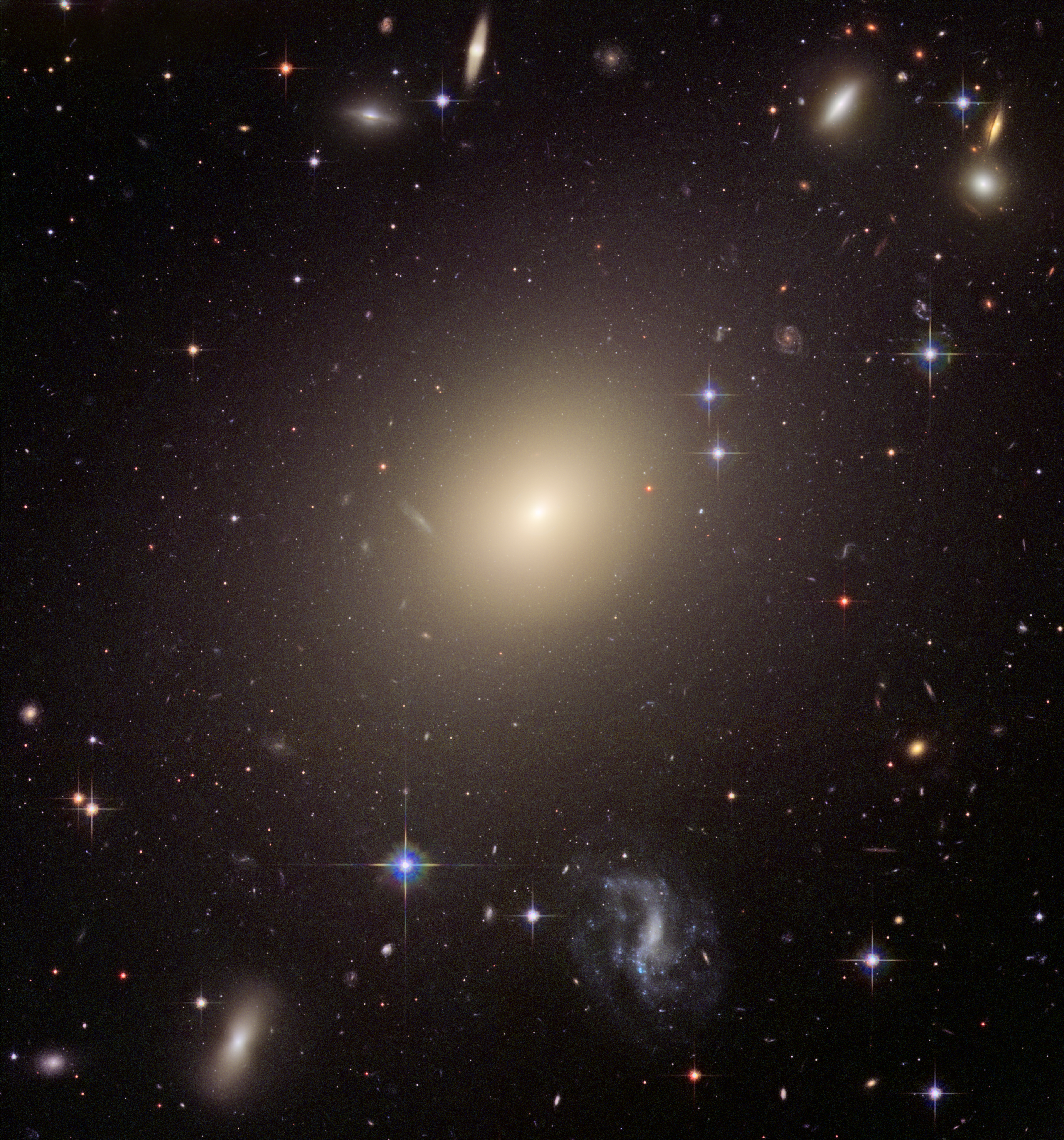
An elliptical galaxy.Credit:
J. Blakeslee (Washington State University

But why are there different shapes of galaxies and what causes them. Well we think it might be due to how galaxies interact with each other. It's generally accepted that Irregular galaxies are the result of merging galaxies and it's thought that Spirals in some way evolve in to Elliptical galaxies. But no one really knows how this happens and is one of the biggest mysteries is astrophysics. But as my research is trying to understand this problem, I should probably stop writing this post and get back to work!

A Spiral Galaxy. Credit: Image: European Space Agency & NASA

Sunday, 14 October 2012

Unplanned public outreach

I had the pleasure yesterday of beginning my public outreach, since starting my PhD. The nice thing was however, I didn't have to visit a school or in fact go anywhere out of my way. Whilst going into the bank to open a new account, I was asked what my job was, and hence what my degree was in. It normally results in a 'Oh' and a long period of silence, a true conversation ender. However the lady serving us in the bank was very interested and even posed me a Physics problem which she didn't understand. This was one of the Physics problems which has been created by humans; we are all taught this problem as kids but the confusion is created in many places in our day to day lives.

Her confusion was as to why one morning she could see both the Sun and the Moon in the sky at the same time. The explanation of this isn't too difficult, but why this problem arises is obvious. If you watch the weather on TV, or look it up on the internet, then daytime weather is always indicated by a Sun, maybe with clouds in front of it (or rain if you live in Cardiff!). In turn the night is represented by the moon. This is also the case is many other places. So why is our idea of the Sun in the day and the moon at night wrong?

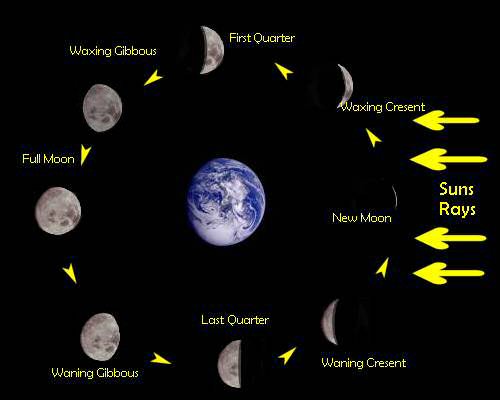
Image courtesy of EarthSky (http://earthsky.org). An image to illustrate the phases of the moon, but it can also be used to explain why we see the sun and moon in the same sky.

In the diagram above, the Sun is to the right. Day and Night is simply the rotation of the earth, which happens every 24 hours. The phases of the moon is the result of its orbit around the Earth, which takes about 27 days. 

The diagram shows that if the Moon is between the Sun and Earth, we don't see any Light reflected off the moon, so it looks dark to us. In this case we would see the Sun and Moon in the same sky at the same time, but the moon is too dark to easily see.

 In the other extreme when the Moon is on the other side of the Earth to the Sun, the Moon is fully illuminated by the Suns light. However in this situation you can never see the Sun and Moon in the same sky, as they are on opposite sides of the Earth.

However there is a range of positions of the Moon, where the Moon and Sun are in the same sky as seen on Earth, and the Sun illuminates enough of it to be seen on Earth. This is why during the day time we can see both the Sun and the Moon.

In the grand scheme of things this is not very important, but it seems a shame that we are teaching people something which is wrong. A simple alternative is to use Stars to indicate night time, but I guess as long as people understand that this is just a misconception, then we can let the Weather people have their Moon!