Showing posts with label News. Show all posts

Tuesday, 27 January 2015

That's no Moon! Oh, wait...

All the worlds doomsayers have been on high alert for the last week as the asteroid 2004 BL86 passed close to the Earth. Of course, when we say close we mean in space scale, which was 1.2 million kilometres, or around 3 times the separation of the Moon and the Earth. The asteroid unsurprisingly passed safely past, as expected (there are many organisations that focus on predicting the paths of asteroids, to watch out for any dangerous ones).

After the panic period, many people were able to spot the asteroid in the night sky last night, which was relatively bright. Such bright asteroids are a rather rare sight, so its always a treat to be able to spot one. But whilst many of us were trying to spot the asteroid with our eyes or binoculars, the team at NASA's Deep Space Network antennae was taking some incredible radio images of the asteroid. Radio waves are reflected off the asteroid which can be seen by the antennae, allowing scientists to see the asteroid even if it isn't illuminated by visible light form the Sun.

http://www.jpl.nasa.gov/images/asteroid/20150126/2004BL86-640.gif
The radio images have allowed scientists to measure the size of the asteroid and study some of the details of its surface. But it was one unique feature that they didn't expect to see. The asteroid has a moon! Just as the Earth has a large body orbiting around it, our very own Moon, the asteroid 2004 BL86 also has a piece of rock orbiting around it. It's had to think of a body 1/40th the diameter of the Earth having enough gravity to have its own visible moon. You can see a time lapse of the asteroid above, where its moon can be seen as the bright spot moving down from the top of the image.

But whilst it was a surprise to the scientists that this particular asteroid has a moon, it's not overall a surprise, as many moons have been found orbiting around asteroids in our Solar System already. Still, it's not something we get to see very often, let alone around an asteroid that we can see clearly in the sky. 

Monday, 26 January 2015

Dwarf planet Ceres shows off its beauty

The NASA spacecraft Dawn, which launched 8 years ago, is finally approaching its final destination, the dwarf planet Ceres. The hard working little satellite has already spent over a year studying the asteroid Vesta, located in the asteroid belt between Mars and Jupiter, and now is on its way through the asteroid belt to Ceres.


As Dawn has been getting closer to Ceres, it's taken some amazing pictures, one of which can be seen above. This picture was taken around 400,000 kilometres from Ceres, but is getting closer and closer and will eventually take the best images we've ever seen of the mysterious little dwarf planet. But even now we can already start seeing some interesting features on the dwarf planets surface. One of which is the bright spot that can be seen on the planets surface (seen below). We don't know yet what causes this, though it is likely a very reflective area on the surface, reflecting back sun light, but we need a bit more time to find out what it is exactly.


The asteroid belt is the remains of planet formation around our sun, that created the Earth and all the other planets billions of years ago. Leftover material formed the ring of rock, dust and ice that forms the asteroid belt, which in turn likely formed Ceres and Vesta. Whilst Ceres is not a proper planet, instead taking the same dwarf classification as Pluto, it was formed in the same way as planets like Jupiter and the Earth, but failed to sweep up all the remaining material in the belt.

With the NASA New Horizons probe reaching Pluto in the near future, this year seems to be the year of dwarf planets. Hopefully we will be able to get some incredible views of these unexplored worlds and better understand how the solar system formed, all those years ago!

Thursday, 21 August 2014

Rosettas comet conundrum

At some point in your life you've probably experienced the holiday headache. Where should we go this for our summer getaway? The south of France, Disney land Orlando, the Great Barrier Reef? Wherever you go, at least you know you will have a great time. The risks involved are pretty small.

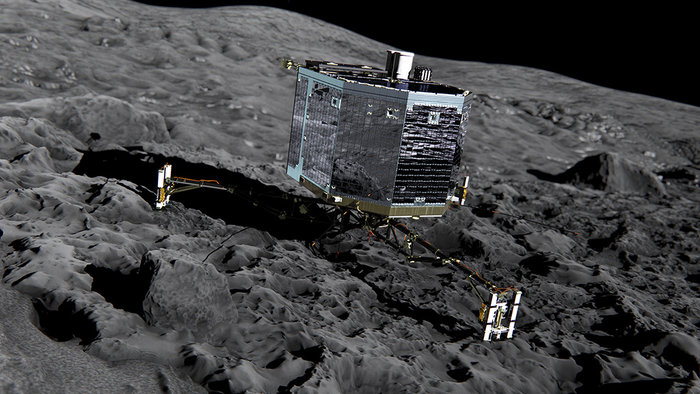
The team behind European Space Agencies mission Rosetta aren't have such an easy task though. Rosetta made contact with the comet 67P-C/G this month. An incredible mission that will study a comet in close detail. It will hope to learn more about what comet structure and composition is as well as learning about the early solar system. It is currently orbiting around the comet, studied the outside of it. But the really exciting part of the mission will happen in November when the lander part of the mission Philae will land on the comet to study its surface.

We don't know much about the surface of comets, but what we do know is very general and is likely to vary from comet to comet. This is worrying for the team that has to land and attach Philae to the comets surface. They would like to land it somewhere stable enough for the lander to remain for the entire mission, somewhere it is unlikely to get damaged, somewhere where it can access the surface of the comet and look as deep in to the centre as possible. The amount of sunlight the lander receives is also vital, ruling out many areas of the comet already due to its spin and unusual shape. This is not your usual holiday headache of where do you go, this is a comet conundrum!

The surface of the comet has been studied for the last couple of weeks since Rosetta has been orbiting the comet and scientists will officially announce in the next week the landing site they have chosen. We will then all keep our fingers crossed for a successful landing in November for what will be an incredible feat for space exploration.

Artist impression of Philae on the surface of 67P/C-G. Credit: ESA/ATG medialab

You can read more about this on the ESA website:
http://blogs.esa.int/rosetta/2014/08/21/landing-site-selection-the-race-is-on/