I have been a unbeliever of Apple products for some time now. I see that they work well, they are powerful and simple to use (though this is probably also their biggest weakness). However my usual criticism is of the astronomical (pun entirely intended) prices they charge for something which is the same as the same product with a picture of an orange on it rather than an apple.
Which is why I now feel a hypocrite as I type this blog on my new iPad.
Admittedly this blog is less about Apple and more about the use of technology in science, and I guess businesses as a whole. For the last few years I have found myself ever increasingly dependant on printers as a way to prove how clever I am to my supervisors. Rushing to their offices with a stack of of pretty graphs and data tables does make one feel very smug. Unfortunately however it also makes the environment feel a little bit sicker. I really do try to do my bit for the environment, but when it comes to this area of environmental heroism I find it hard to change.
So to change this habit I have bought an iPad. My aim is to start flaunting my pie charts on its beautiful high resolution screen, rather than on dead vegetation. I'm not sure how well the iPad is set up to do many of these things, especially how good it is and linking up to my unix based work machine, but I'm going to try. If all else fails, I will become the true master of angry birds.
I hope that just as apple seems to have introduced content for the iPad for people in business and education, such as university lectures, that someone will take this a step further and allow people to fully integrate their day to day work with a tablet. Not for cash in their pockets, but trees in the forests.
I still believe iPads are too expensive. But in a philosophical tone, isn't the cost to the environment even more costly.
Wednesday, 14 November 2012

Wednesday, 7 November 2012
Physics isn't the only science
We have plenty of seminars and meetings at University to encourage to keep and interest in other areas of Astrophysics and Physics. It's through this knowledge of other disciplines that links and connections can be made, producing new areas of research involving the whole department.
However one also has to remember that there are other sciences out there other than Physics! So this brief post is dedicated to the Science of Biology. To illustrate the incredible nature of Biology I present to you this video made by Harvard University (from what I can gather).
However one also has to remember that there are other sciences out there other than Physics! So this brief post is dedicated to the Science of Biology. To illustrate the incredible nature of Biology I present to you this video made by Harvard University (from what I can gather).
Video from Youtube, courtesy of Harvard University.
This incredible video is an artists simulation of the inside of a cell, though based on real research and knowledge. I had to have the various things in the video explained, but a brief explanation is as follows.
The video shows the inner working of a single cell. Your body is made up of over 50 trillion cells, which is incredible enough, without knowing what happens inside them. Most of the little things you can see in the video are proteins, all with various different jobs to make your cells do what they're supposed to, in turn making your organs perform as a whole.
It's these kind of videos which really make science and research appealing to people, yet I never saw this at school or college; it took till my PhD in another discipline to first see this video! It's a shame, but if you search hard enough gems like this can be found and hopefully shared to everyone else!
Tuesday, 16 October 2012
4 sunsets, 4 times the romance!
1 sunset on earth is beautiful enough, but imagine being able to see 4 different suns set. On the other hand anyone who knows anything about orbit mechanics will know that it's hard enough to imagine a planet in a binary star system (2 suns, 1 planet), but 4 stars and 1 planet seems impossible. Well, not surprisingly, such a system has been discovered (http://www.bbc.co.uk/news/science-environment-19950923), and so we welcome planet PH1 to the ever growing list of exoplanets (planets around other stars apart from our own Sun). This is a fascinating system as planets need to sit in stable orbits, that is a repeating orbit which will save it from being flung out into dark empty space. This isn't easy to imagine when you have 4 strongly attracting Stars nearby, nor how it formed in such a system.

This is a nice example of Observation and Theoretical Astrophysics combining: observation discovers a phenomenon, allowing theorists to begin modelling it, now knowing that it is indeed possible in nature.
Incidentally, the PH name comes from Planet Hunters, a website (http://www.planethunters.org/) where you can, very simply, look for exoplanets. I just spent some time doing this and it's mildly addictive and fun to do. All you have to do is look for dips in a collection of data points, pointing to a planet passing in front of a star. If you find one you even get your name mentioned!
If they had only called it 'Angry Exoplanets' I'm sure many more people would play around with it!

Image courtesy of BBC. This is an Artists Impression of PH1, the new exoplanet found with 4 suns!
This is a nice example of Observation and Theoretical Astrophysics combining: observation discovers a phenomenon, allowing theorists to begin modelling it, now knowing that it is indeed possible in nature.
Incidentally, the PH name comes from Planet Hunters, a website (http://www.planethunters.org/) where you can, very simply, look for exoplanets. I just spent some time doing this and it's mildly addictive and fun to do. All you have to do is look for dips in a collection of data points, pointing to a planet passing in front of a star. If you find one you even get your name mentioned!
If they had only called it 'Angry Exoplanets' I'm sure many more people would play around with it!
Sunday, 14 October 2012
Unplanned public outreach
I had the pleasure yesterday of beginning my public outreach, since starting my PhD. The nice thing was however, I didn't have to visit a school or in fact go anywhere out of my way. Whilst going into the bank to open a new account, I was asked what my job was, and hence what my degree was in. It normally results in a 'Oh' and a long period of silence, a true conversation ender. However the lady serving us in the bank was very interested and even posed me a Physics problem which she didn't understand. This was one of the Physics problems which has been created by humans; we are all taught this problem as kids but the confusion is created in many places in our day to day lives.
Her confusion was as to why one morning she could see both the Sun and the Moon in the sky at the same time. The explanation of this isn't too difficult, but why this problem arises is obvious. If you watch the weather on TV, or look it up on the internet, then daytime weather is always indicated by a Sun, maybe with clouds in front of it (or rain if you live in Cardiff!). In turn the night is represented by the moon. This is also the case is many other places. So why is our idea of the Sun in the day and the moon at night wrong?

Her confusion was as to why one morning she could see both the Sun and the Moon in the sky at the same time. The explanation of this isn't too difficult, but why this problem arises is obvious. If you watch the weather on TV, or look it up on the internet, then daytime weather is always indicated by a Sun, maybe with clouds in front of it (or rain if you live in Cardiff!). In turn the night is represented by the moon. This is also the case is many other places. So why is our idea of the Sun in the day and the moon at night wrong?
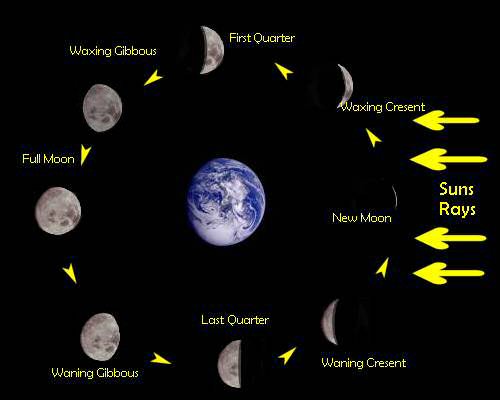
Image courtesy of EarthSky (http://earthsky.org). An image to illustrate the phases of the moon, but it can also be used to explain why we see the sun and moon in the same sky.
In the diagram above, the Sun is to the right. Day and Night is simply the rotation of the earth, which happens every 24 hours. The phases of the moon is the result of its orbit around the Earth, which takes about 27 days.
The diagram shows that if the Moon is between the Sun and Earth, we don't see any Light reflected off the moon, so it looks dark to us. In this case we would see the Sun and Moon in the same sky at the same time, but the moon is too dark to easily see.
In the other extreme when the Moon is on the other side of the Earth to the Sun, the Moon is fully illuminated by the Suns light. However in this situation you can never see the Sun and Moon in the same sky, as they are on opposite sides of the Earth.
However there is a range of positions of the Moon, where the Moon and Sun are in the same sky as seen on Earth, and the Sun illuminates enough of it to be seen on Earth. This is why during the day time we can see both the Sun and the Moon.
In the grand scheme of things this is not very important, but it seems a shame that we are teaching people something which is wrong. A simple alternative is to use Stars to indicate night time, but I guess as long as people understand that this is just a misconception, then we can let the Weather people have their Moon!
Friday, 12 October 2012
Another week, another book
So my second week of PhD research is done and I finally feel I am understanding the papers and work I have to read up on. 5 papers and 2 text books later. I also made the clever decision of just borrowing books from the library, after buying three books in one week.
Undergraduate Labs this week consisted of proper experiments: Friction down a slope and the Youngs Modulus of Wood (the measure of elasticity/stiffness of a material). This consists of people sliding pieces of wood down a slope and seeing how far they could bend a ruler; many of the students seeing this as a challenge not an experiment. This will mean the lab books are a bit more interesting to mark this week.

I'm planning to go to Brecon Beacon this weekend after reading that the skies there are really good for seeing the stars at night. Supposedly in good enough conditions you can see the Milky Way, which appears as a bright belt across the sky. I've never been there anyway and it's supposed to be very nice, so it's win either way. A website to find dark sky locations is here: http://www.darkskydiscovery.org.uk/dark-sky-discovery-sites/map.html but I'm sure there are other sites to look them up if you're not in the UK.
Undergraduate Labs this week consisted of proper experiments: Friction down a slope and the Youngs Modulus of Wood (the measure of elasticity/stiffness of a material). This consists of people sliding pieces of wood down a slope and seeing how far they could bend a ruler; many of the students seeing this as a challenge not an experiment. This will mean the lab books are a bit more interesting to mark this week.

Image courtesy of BBC. Image of the Night Sky in Brecon Beacon.
I'm planning to go to Brecon Beacon this weekend after reading that the skies there are really good for seeing the stars at night. Supposedly in good enough conditions you can see the Milky Way, which appears as a bright belt across the sky. I've never been there anyway and it's supposed to be very nice, so it's win either way. A website to find dark sky locations is here: http://www.darkskydiscovery.org.uk/dark-sky-discovery-sites/map.html but I'm sure there are other sites to look them up if you're not in the UK.
Saturday, 6 October 2012
Marking done, papers and Dinosaurs on the go!
Morning to myself today so I managed to finally get all of my marking done. 9 lab books, probably 20 minutes on average per book, not too bad. Apparently it gets easier and quicker as you do more, but getting it under the recommended 2 hours looks difficult! The standard of the lab books was very good, I even had to get someone to come check my marking as I thought I was giving too good marks!
I now have the rest of the weekend to read a few papers I brought home, which I would love to say are very cool and interesting Astro papers, but unfortunately they are just papers on probability, something which I will be doing for at least the first part of my PhD.
The papers deal with comparing detections of galaxies in two different catalogues of data (such as the images of the sky taken with Herschel[http://en.wikipedia.org/wiki/Herschel_Space_Observatory] and the images of the sky taken with the Sloan Digital Sky Survery [http://en.wikipedia.org/wiki/Sloan_Digital_Sky_Survey]). Because they observe the sky in two different wavelengths, or areas of the Electro Magnetic Spectrum, it is difficult to automate matching between the objects in both surveys. That is to say, a computer programme to find the same object in both images. The papers deal with a method of probability to identify the best candidate galaxy in one set of data to link to a galaxy in the other set, based on how close they are and if they have the same/similar brightnesses. Very cool (if you like statistics) but blooming hard to understand. Still, I'm doing this whilst watching Jurassic Park, so it's not too bad....
Thursday, 4 October 2012
A hectic first few days!
Well, I planned to keep you informed with every event of my first week at work, but as expected by everyone that me it has been very busy.
I'm currently sat down watching the TV, something which I haven't had a lot of time to do, which makes me appreciate it more.
I have now officially been moved into my office, taking up the old coffee table in the corner of the room. I've got my computer and after a few hiccups it seems to be going OK (except the cleanliness of the keyboard and mouse, which I shall not describe!). I've got a few shelves above the desk which have already been filled up with 2 new books I have bought, on Maths and Dust, with one more on statistics on the way. Thrilling bed time reads!

I had a brief meeting with my supervisor in which he told briefly what my project would be, but I'm hoping we have a bit of a longer chat some time. We have lots of opportunities to do go on training courses, for a wide range of different skills, a few of which I think would be useful but I will talk to my supervisor first.
I've found that a lot of my time at uni is spent drinking coffee or eating! This makes us sound very lazy, but actually it's been a great way to meet people, find out what research we do at Cardiff and to learn of things which might be useful for my project. We've also had one talk from someone external to the university (http://www.physics.lancs.ac.uk/people/anupam_mazumdar.php) on Gravity, which looks pretty scary, but he explained it very well. He discussed how at short distances (and early in the universe) Gravity may not have (had) the same strength as it does today, which is new to me!
I also undertook my first Lab demonstrating session today. The first year university students undertake a laboratory module every week and to help them some of the PhD students going around the class helping them out. There are obvious benefits of getting experience and learning to teach/communicate with young physicists, but there are other benefits such as re-capping on bits of physics I haven't touched in years. I also have to mark their lab books, which I don't think is as fun!
After things settle a bit I'll try to talk a bit more about Physics, including the work I do and work I learn and hear about at Cardiff. Also pretty pictures!
I'm currently sat down watching the TV, something which I haven't had a lot of time to do, which makes me appreciate it more.
I have now officially been moved into my office, taking up the old coffee table in the corner of the room. I've got my computer and after a few hiccups it seems to be going OK (except the cleanliness of the keyboard and mouse, which I shall not describe!). I've got a few shelves above the desk which have already been filled up with 2 new books I have bought, on Maths and Dust, with one more on statistics on the way. Thrilling bed time reads!

I had a brief meeting with my supervisor in which he told briefly what my project would be, but I'm hoping we have a bit of a longer chat some time. We have lots of opportunities to do go on training courses, for a wide range of different skills, a few of which I think would be useful but I will talk to my supervisor first.
I've found that a lot of my time at uni is spent drinking coffee or eating! This makes us sound very lazy, but actually it's been a great way to meet people, find out what research we do at Cardiff and to learn of things which might be useful for my project. We've also had one talk from someone external to the university (http://www.physics.lancs.ac.uk/people/anupam_mazumdar.php) on Gravity, which looks pretty scary, but he explained it very well. He discussed how at short distances (and early in the universe) Gravity may not have (had) the same strength as it does today, which is new to me!
I also undertook my first Lab demonstrating session today. The first year university students undertake a laboratory module every week and to help them some of the PhD students going around the class helping them out. There are obvious benefits of getting experience and learning to teach/communicate with young physicists, but there are other benefits such as re-capping on bits of physics I haven't touched in years. I also have to mark their lab books, which I don't think is as fun!
After things settle a bit I'll try to talk a bit more about Physics, including the work I do and work I learn and hear about at Cardiff. Also pretty pictures!
Subscribe to:
Posts (Atom)