Thursday, 29 January 2015

Goodbye Dippy the dinosaur

'Save Dippy', they screamed from the rooftops.

If you've never visited the London Natural History Museum then you probably have no idea who Dippy is (I must admit, I didn't know he/she had a name). But it seems that there is a secret underground following for this plaster cast model of a Diplodocus skeleton. After the museum announced today that it would be switching the model skeleton in 2017 with the real skeleton of Whaley (yes, I just made up that nickname, shut up), the 25m skeleton of a whale that was beached in Ireland in the late 1800's.


Petitions and fake twitter accounts have been set up to bring attention to this travesty of museum exhibitions and to convince the museum to reverse it's decision. Sure, it's always sad to see a friend packed in to a storage box in the back of a museum (not from personal experience), but Dippy has had a 35 year long life in the front hall of the museum, which is pretty incredible for a skeleton that isn't even real!

And that's the main argument from the museum for changing the exhibits. Whilst the dinosaur is a paper cast model of a relatively unknown dinosaur, Whaley (this nicknames going to stick, I swear) is a real skeleton of a whale whos life and death are relatively well known. It's also an incredible example of a whale skeleton, with every bone present. Sure dinosaurs have a certain romance to them (if you're in to giant lizards), but at the end of the day it's essentially a papier-mache model. Surely it's better to flaunt off the incredible real life skeletons instead?

But if you're still not convinced by the museums arguments, then go ahead and sign the petition and spam social media with your love for Dippy. But personally, I'm looking forward to welcoming Whaley, to the front hall of a museum I will probably not visit for many years again, in 2017.

Tuesday, 27 January 2015

That's no Moon! Oh, wait...

All the worlds doomsayers have been on high alert for the last week as the asteroid 2004 BL86 passed close to the Earth. Of course, when we say close we mean in space scale, which was 1.2 million kilometres, or around 3 times the separation of the Moon and the Earth. The asteroid unsurprisingly passed safely past, as expected (there are many organisations that focus on predicting the paths of asteroids, to watch out for any dangerous ones).

After the panic period, many people were able to spot the asteroid in the night sky last night, which was relatively bright. Such bright asteroids are a rather rare sight, so its always a treat to be able to spot one. But whilst many of us were trying to spot the asteroid with our eyes or binoculars, the team at NASA's Deep Space Network antennae was taking some incredible radio images of the asteroid. Radio waves are reflected off the asteroid which can be seen by the antennae, allowing scientists to see the asteroid even if it isn't illuminated by visible light form the Sun.

http://www.jpl.nasa.gov/images/asteroid/20150126/2004BL86-640.gif
The radio images have allowed scientists to measure the size of the asteroid and study some of the details of its surface. But it was one unique feature that they didn't expect to see. The asteroid has a moon! Just as the Earth has a large body orbiting around it, our very own Moon, the asteroid 2004 BL86 also has a piece of rock orbiting around it. It's had to think of a body 1/40th the diameter of the Earth having enough gravity to have its own visible moon. You can see a time lapse of the asteroid above, where its moon can be seen as the bright spot moving down from the top of the image.

But whilst it was a surprise to the scientists that this particular asteroid has a moon, it's not overall a surprise, as many moons have been found orbiting around asteroids in our Solar System already. Still, it's not something we get to see very often, let alone around an asteroid that we can see clearly in the sky. 

Monday, 26 January 2015

Dwarf planet Ceres shows off its beauty

The NASA spacecraft Dawn, which launched 8 years ago, is finally approaching its final destination, the dwarf planet Ceres. The hard working little satellite has already spent over a year studying the asteroid Vesta, located in the asteroid belt between Mars and Jupiter, and now is on its way through the asteroid belt to Ceres.


As Dawn has been getting closer to Ceres, it's taken some amazing pictures, one of which can be seen above. This picture was taken around 400,000 kilometres from Ceres, but is getting closer and closer and will eventually take the best images we've ever seen of the mysterious little dwarf planet. But even now we can already start seeing some interesting features on the dwarf planets surface. One of which is the bright spot that can be seen on the planets surface (seen below). We don't know yet what causes this, though it is likely a very reflective area on the surface, reflecting back sun light, but we need a bit more time to find out what it is exactly.


The asteroid belt is the remains of planet formation around our sun, that created the Earth and all the other planets billions of years ago. Leftover material formed the ring of rock, dust and ice that forms the asteroid belt, which in turn likely formed Ceres and Vesta. Whilst Ceres is not a proper planet, instead taking the same dwarf classification as Pluto, it was formed in the same way as planets like Jupiter and the Earth, but failed to sweep up all the remaining material in the belt.

With the NASA New Horizons probe reaching Pluto in the near future, this year seems to be the year of dwarf planets. Hopefully we will be able to get some incredible views of these unexplored worlds and better understand how the solar system formed, all those years ago!

Thursday, 25 September 2014

The problem with Pluto

Like most of you, I spent the majority of my life being taught that there are 9 planets in the solar system: Mercury, Venus, Earth, Mars, Jupiter Saturn, Uranus, Neptune, Pluto. We were never really taught much about the planets or how they were defined, so we sat happy in our little bubbles.

It obviously came to a shock in 2006 when scientists decided to re-classify what a planet was. But the logic behind their decision does make some sense. More massive objects have been found in the Solar System along with objects of comparable sizes and shapes. The meeting in 2006 wasn't called to demote Pluto. It was called to decide what the definition of a planet should be. These other objects could have been included and we could realistically today be looking at a Solar System with nearer 15 recognised planets. But the requirement was made such that Pluto and the other smaller bodies were re-classified as Dwarf Planets.

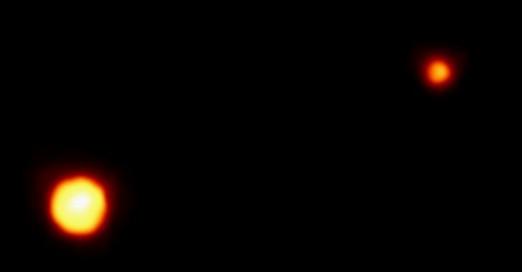
Credit: R. Albrecht (ESA/ESO), NASA. http://apod.nasa.gov/apod/ap990213.html


Whilst the arguments and classification may not have been wholly accepted, it was at least based on science.

But it seems that there has been a revolution happening. When presented with the arguments, a group of people from the general public voted that Pluto should be reinstated at a meeting at Harvard University last week. It seems that many people disagree with the previous decision and want change!

But the meeting raises some interesting points. A large part of the argument to re-instate Pluto seems to come from a cultural and historical viewpoint. Pluto was considered a planet for 76 years, it seems wrong to suddenly change this. But the best thing about science is it's lack of opinion. Science is based on facts, statistics and logic. It was these tools that were used to change the status of Pluto and it's these tools that should be used for everything in science. When it was discovered that the Earth wasn't the centre of the solar system there was a huge uproar from people who believed it went against their religion, but now we look back at this and laugh (hopefully!).

So it may be that some day the definition of a planet is revisited and perhaps changed. But I just hope that this is due to scientific reasoning and not people feeling sorry for a giant piece of rock in space...


Tuesday, 16 September 2014

Galaxy swirls and blobs

Galaxies are like islands in the universe. They are the giant collections of stars, planets, gas, dust, black holes and the elusive Dark matter, that are dotted throughout the universe. They are often separated by millions of light years from their nearest neighbours with not much in-between. As we sit inside our galaxy, the Milky Way, it is often difficult to remember that we are just like one of those distant galaxies.

But every galaxy is unique. The Milky Way forms stars like most galaxies, contains the same things and are in general a very 'vanilla' galaxy, yet events throughout the life of the Milky Way has changed and shaped it to make it different from every other.

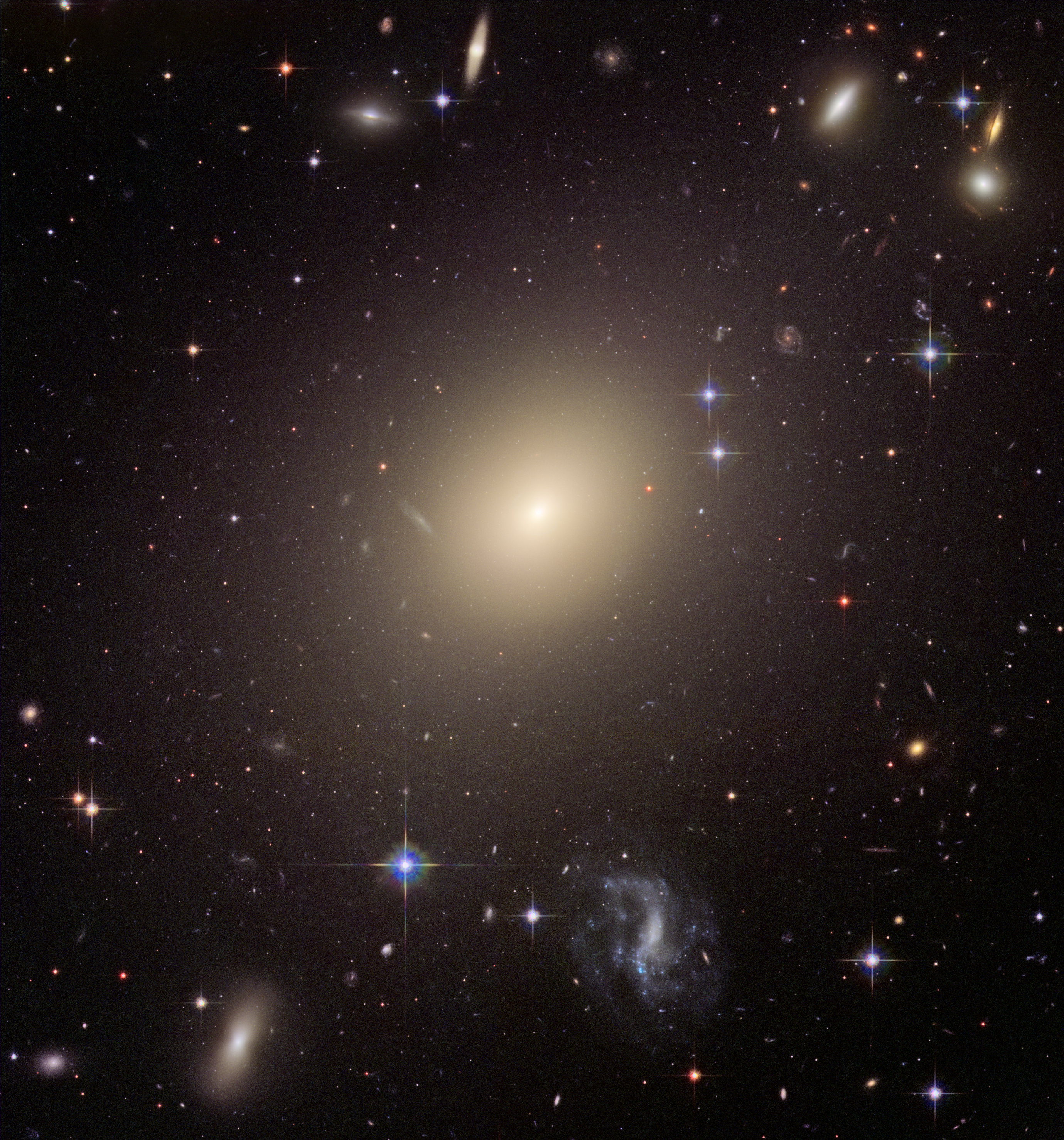
One of the most recognised difference between galaxies is their shape. This can be seen if you simply look at galaxies. Many of us if told to draw a galaxy would draw a big disk with spiral arms stretching out from the centre, because this is often the type of galaxy we see most in images (probably because they are the most stunning to look at). But these Spiral galaxies are not the only inhabitants of the universe. Giant spherical Elliptical galaxies with bulges of stars at the centre dominate the universe, containing the majority of all the stars. These galactic giants are very different from the beautiful spirals, both in looks and properties, on average forming much less stars and typically being much less active. Then there are Irregular shaped galaxies, those that look like no other due to their disturbed shapes. These can be elongated, squashed or take some shape that barely looks like a galaxy any more.

An elliptical galaxy.Credit:
J. Blakeslee (Washington State University

But why are there different shapes of galaxies and what causes them. Well we think it might be due to how galaxies interact with each other. It's generally accepted that Irregular galaxies are the result of merging galaxies and it's thought that Spirals in some way evolve in to Elliptical galaxies. But no one really knows how this happens and is one of the biggest mysteries is astrophysics. But as my research is trying to understand this problem, I should probably stop writing this post and get back to work!

A Spiral Galaxy. Credit: Image: European Space Agency & NASA

Monday, 8 September 2014

Wishing I was at British Science Fest

Work is still relatively quiet as some academics are making the last of the summer break, some people at work are observing at a telescope for the next couple of weeks and the students aren't back for another few weeks. But I'm stuck here doing work, like I'm supposed to (boo!).

I don't really mind, I do love my work, but this week I wish I was also somewhere else. I wish I wish I was at British science fest!

This annual science festival is one of the biggest places for all things sciencey. Over a week there are loads of great activities at the festival, based in Birmingham in the UK this year. The activities vary from talks on turning rubbish in to energy to a demonstration of how to walk on custard. The activities are generally at a level accessible by all ages and science knowledge, providing a great place for scientists and science lovers (not that they are mutually exclusive) together.

If you love science and have some spare time next year, or can pop down in the next few days, it's a really great place to go.

Check out their website for schedule and for info!
http://www.britishscienceassociation.org/british-science-festival

Monday, 1 September 2014

Meeting my great great Supervisor

It seems that one of the big things in the last few years are websites and programs about tracing your family tree. These online services allow you to enter your name and search records, such as birth and marriage certificates, and trace your family tree.
Well, there is a website (http://phdtree.org/) that take the family tree idea and puts a new edge on it. It allows scientists to trace their supervisor tree.
During your PhD, postdoc and undergraduate you will have a supervisor (essentially just your boss) who will help and advise you. Almost all scientists will have a supervisor during their academic studies, meaning that your supervisor also had a supervisor. And they had a supervisor and so on, all the way back hundreds of years. Many of the great greek philosophers were supervised/trained by other philosophers. So there is obviously an appeal to find out your supervisor family tree. Does your tree contain any famous scientists?
So I looked up my supervisor and found my academic genealogy and the results are pretty cool! A few generations back is Ernest Rutherford, who is famous for his revolutionary work in nuclear and particle physics. For example, he discovered and named the proton, one of the 3 particles that makes up an atom.
Go back a lot more layers and you reach Isaac Newton, the man famed for his work on understanding Gravity. A few levels above him is Galileo, the famous mathematician, physicists and astronomer. I could keep going back further, but the tree is so good that it's taking me some time to check every branch.
Finding out that these incredible people have passed down their knowledge and experiences through to me through a long list of supervisors gives me a very good feeling.
So if you are a scientist, go check out the website. If not, then why not pick a famous scientist and check their supervisor tree to see what other scientists are in their tree.